The AI Disruption

By: James Perreault

Disruptive technologies don’t change what people want—they change how easily people can get it. Photography evolved from a specialized, skill-intensive craft into an everyday activity through digital cameras and AI-driven computational photography. While this lowered barriers and democratized image capture, it didn’t eliminate the need for artistry; professionals still thrive where nuance, control, and intentional creation matter.

The same pattern is now unfolding in software development. AI has dramatically reduced the barrier to building functional applications, making it accessible to non-experts. However, just as a smartphone camera doesn’t replace a skilled photographer, AI-generated software doesn’t replace experienced developers where complexity, quality, and purpose are critical. The true differentiator remains the creator—not the tool—and those who learn to wield new tools thoughtfully will continue to stand apart.

Disruptive technologies bring disruptive change for businesses. I’d like to take a deep dive into a recent example that my fellow Xennials lived through: photography.

When I was young, photos were almost exclusively a physical medium. You typically paid a service to develop your own photos. You didn’t need to have a darkroom or know about the chemistry of negative development, but you did need to purchase film and have the negatives developed and printed, usually as a 4×6 print. Because of the cost, we were judicious with what we photographed. If we had something important to capture, we hired a professional photographer.

Film photography was the principal way to capture memories. With that said, the method by which a visual memory is captured isn’t actually the goal for most people. Whether an image is drawn, painted, printed, or viewed on a screen, the end result is an image of a particular feeling or place or person in a moment in time. If you have the time and the talent of Michaelangelo, Van Gogh, or Bob Ross, a painting may be the best medium in which to capture the memory, idea, or emotion. Indeed, for thousands of years, paint was the leading method by which images were preserved. Then in the mid-1800’s, photography started to be a viable technology. Around 1900, the Kodak Brownie made photography affordable for almost everyone and by 2000, digital photography was entering the scene for consumers. Each new technology made capturing images easier and more accessible to more people.

Throughout these innovations, the impetus remained the same. People want to capture that which they feel is important to remember. Technological innovations enable, not create, this desire. Customers did not desire film specifically, they wanted to capture memories without paint. Customers didn’t drive the development of digital photography for its own sake, they wanted to take advantage of imaging without the ongoing costs and hassle of film, printing, and scanning. As digital photography took off, the medium in which we view and share photos likewise evolved from framed images to photo albums, to digital albums, to social media. Yet despite digital imaging supplanting the majority of the previous methods, paintings are still created, framed, and hung today. Photos are still captured on film, printed and framed. The older methods didn’t disappear, but they became more niche and specialized, accompanied by nostalgia and talk of superior highlight roll-off and the organic nature of grain.

The rise of digital photography was meteoric. The first digital cameras targeted for consumers were released in the late 1990s and by 2004, sales of digital cameras surpassed those of film cameras. Digital photography quality was good enough and cheap enough that customers were starting to prefer digital capture to film capture. That same year (2004), Apple started developing a new device that would eventually be released in 2007 as the iPhone. Just five years later, in 2012, Kodak would declare bankruptcy. In 2016 with the release of the iPhone 7, Apple’s multi-lens camera system and device ubiquity would make it the most common camera system in the world, less than 10 years after its introduction! (https://www.cnet.com/tech/mobile/iphone-top-camera-flickr-2017-report/) Companies that didn’t quickly adapt to digital were left behind.

The exodus from film may seem counterintuitive to those that have studied the limitations of light, optics and photography. The iPhone’s lens and sensor are small and physics accurately describes the limitations of optics and photography. (https://www.northlight-images.co.uk/downloadable_2/Physical_Limits.pdf). This paper describes how, in 2009, we were already approaching the theoretical maximum quality that can be achieved out of a camera sensor of given size. Anecdotally, we have a DSLR (a Canon EOS 6D) that was designed in 2012 that still takes much higher quality photos than even the latest smartphones in 2026. So why then did image quality in smartphones continue to improve significantly post 2009? Physics dictates that there is no way that a relatively small sensor in a phone can compete with the image quality of a large sensor found in large SLR cameras. It follows that one obvious means of improvement in the iPhone has been the size of the image sensor. The original iPhone’s image sensor measured around 3.5mm wide, the iPhone 7’s image sensor had a width of about 5mm while the iPhone 16’s image sensor was about 11mm wide. This still pales in comparison to the 35mm width of the 6D but is nonetheless a huge improvement in a small device. However, image sensor size alone is not enough to explain the dramatic improvement in image quality since it’s still relatively small and optically limited. The explanation lies in the iPhone 7’s inclusion of “computational photography” which uses multiple lenses and sophisticated software incorporating Machine Learning and AI to appear to overcome physics. This approach is what allowed the iPhone to produce photos that rival larger cameras and to become the de facto camera in most people’s lives.

As an aside, I want to apologize to my Android-carrying friends and family, some of whom are yelling at the screen about how their phone’s camera output is superior to the iPhone. I know you have wonderful cameras too, but for simplicity, I’m only referencing the iPhone. The two systems are effectively equal for the purposes of this story so I respectfully ask that you let it go for now.


All of the technological innovations are fascinating to me but we shouldn’t lose sight of the reason for all of this technological improvement. The average user doesn’t know or care that their iPhone is dancing around the laws of physics in order to deliver high quality photos of their dinner. The average user only cares about their goal, to capture that which they feel is important to remember. Recent technological innovations have lowered the barriers to doing so by a staggering amount. What once required specialized knowledge, skills and tools can now be accomplished by a device that’s always in your pocket. Or, at least that’s what most people believe.

The technology isn’t the full story. The aspect of photography that elevates it from simple memory capture to art is the artist. (A few of the greats are listed here if you’re interested: https://www.wardynskiphoto.com/gallery/the-best-photographers-of-all-time/.) As with all artists, the tools of the trade are less important than the skill the artist brings to the craft. Bob Ross can create a beautiful landscape with cheap paints and brushes. Jimi Hendrix or B.B. King would still produce fantastic music on an entry level guitar. And Ansel Adams could take a beautiful picture with a point-and-shoot camera. Each of these artists had specific paint, brushes, guitars, and cameras that they preferred, those that allowed them to maximize their creative vision, but even the best, most advanced tools do not create art without the artist. The artist is still the most critical variable in the process of creation. Having easy access to a high quality camera in your pocket does not guarantee that the photos captured will be of high quality too. Post-processing, Photoshop, and AI can all improve upon a photo, but they are limited by the source material.

One of the down-sides of this progress that accompanied the ubiquitous ability to capture high quality photos is a lowering of standards and expectations. The average consumer can not describe the differences between a professional photo shoot and a set of photos taken by their friend on an iPhone, and they don’t need to. Their goal is to capture what they feel is important to remember, and photos taken on an iPhone rekindle the memory as well as a photo taken with a medium format camera. The ease with which we can snap a photo combined with the high technical quality and sheer number we can capture (at almost no cost per picture) has lowered the value of photography’s output. Your average person places a higher value on immediacy and volume than on artistic or technical quality. This can create a difficult environment for a professional photographer since their higher quality output is valued less than it once was.

Why then are those bulky cameras still around and used by professionals? Today, it’s rare for non-professionals to take photos with a dedicated camera, if they even own one. The iPhone has become the only camera most people own or use. Computational Photography is amazing but physics dictates that it can only ever produce an approximation of what a higher quality camera can produce. Artists, professional photographers, art curators, and any other profession where control, nuance and fine detail matter still prefer the performance and output of large-sensor cameras. With that said, many professionals have integrated an iPhone into their workflow alongside their dedicated camera for rapid prototyping, rapid sharing or for non-critical shots. To ignore the capabilities and impact of the iPhone is to invite the end of a photographer’s career.

The key then, to surviving as a photographer in a world in which the iPhone exists, is to figure out the spaces and places where artistry, nuance, and fine detail are critical. Outside of the art world, businesses still rely on professionals for their image capture. Customers may not value the quality output of a professional for their daily memory capture, but expectations are different when they are purchasing an art print for their wall, when they visit an art gallery, or when perusing a catalog of products or viewing marketing material. There are still plenty of use cases where we expect and value, sometimes subconsciously, images that are created deliberately by a skilled individual with high quality tools.

Kristen is, in my admittedly biased opinion, capable of producing art with a camera. Her best work is created with her trusty 6D but her iPhone photos are also great. Despite having worked alongside her casually with a camera for decades, even today we can stand in the same spot and capture the same scene with the same camera and somehow, her photos are always obviously better than mine. Out of 10 shots, I am lucky to get one worth keeping compared to hers. It’s good, then, that she’s the professional photographer and not I. When I’m not admiring and supporting Kristen at https://kpcreates.com, my day job, passion, and profession lies in software development.

What do I take from the above indulgence into the history of photography and its disruptive technologies that can be applied to the software development industry? I think it’s important to first acknowledge that software development is a form of creation, a form of art. Film photography started out requiring specialized knowledge of chemistry to develop and fix negatives and evolved into a service where undeveloped negatives could be sent off and returned as printed photos. It further evolved into a form where the entire workflow could take place on a single device, from capture to display in fractions of a second. People no longer need to know how to take a photo. If they want to capture a memory, they pull out their phone, point, tap, and immediately see what was captured. But even with the ease of capture, producing a gallery-quality photo still requires knowledge and skill beyond the average person’s abilities.

Software development tools have evolved from punchcards to assembly to compiled code to intermediate and interpreted code. The training and skills required to create applications has likewise evolved from requiring multiple years of experience in mathematics, algorithms, architecture, and graphic design to asking one AI to develop an efficient prompt for another AI that builds an app for you, complete with database, API’s and a polished UI. Don’t worry, I won’t bore you with a recounting of this industry too.

Like with photography’s iPhone, the barrier to create everyday applications has been lowered by AI to something most people can do in a few minutes or hours. The final product will appear for most people to have similar quality to a well-designed application. The applications generated by consumers using AI will be perfectly sufficient for personal and small scale use. However, there are still places where the specialized talents and knowledge of experienced software developers, testers, analysts, graphic designers, infrastructure and operations specialists are required to take the application to the necessary level.

The tool that creates the application isn’t the end goal. Software applications are created to serve a need for people and we need to keep that purpose in sight as we necessarily embrace and integrate these new powerful tools. Learning how to use these new tools and choosing the right tool for a given problem is where the great artists will separate themselves.

Spring Break Kayaking 2025

This year, for spring break, I took 4 days off of work. I wanted to spend one day with each of the boys and what better way than outside where there’s no cell service?!

I have fond memories from my childhood of canoeing with my grandpa. There are a few lakes nearby connected by canals that provide for a nice trip. If you’re in the area, I recommend booking a seat on the scenic boat tour. It’s an inexpensive diversion and the captains always provide some entertaining facts about the area. For example, one of the houses on the lake is where Mister Rogers lived while he attended the local college.

Jamie, at 4 years old, riding in the canoe with Mom, Grandpa, and cousin on the Winter Park chain of lakes

I still have the canoe from the picture above. It hangs in my garage and still works great! Paddling on the lakes is fun, but the place I have the fondest memories of is the Rock Springs Run. A short 45-minute drive from our house, this 8 mile long spring-fed river through protected forest area is part of the “first congressionally designated National Wild and Scenic River basin in Florida.” https://www.floridastateparks.org/parks-and-trails/rock-springs-run-state-reserve/history. It’s on this river that I remember learning how to properly pilot a canoe.

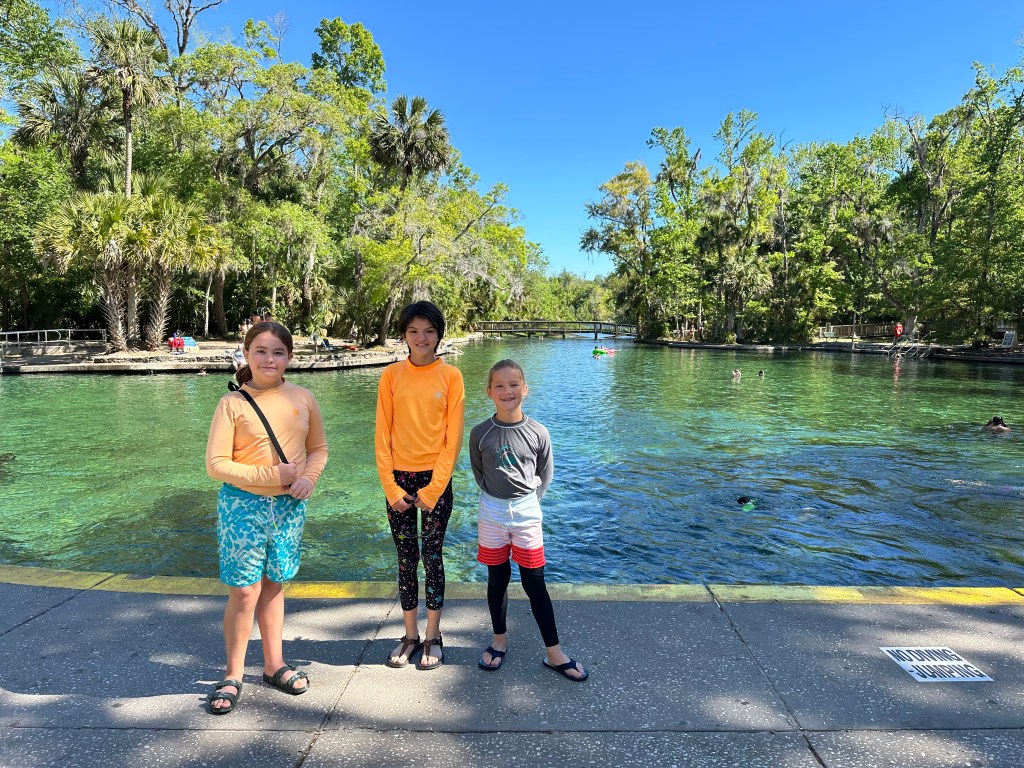
The plan for spring break was to paddle the Rock Springs Run, from King’s Landing to Wekiva Island, maybe with a side quest to swim in Wekiva Springs.

Understanding the waterway

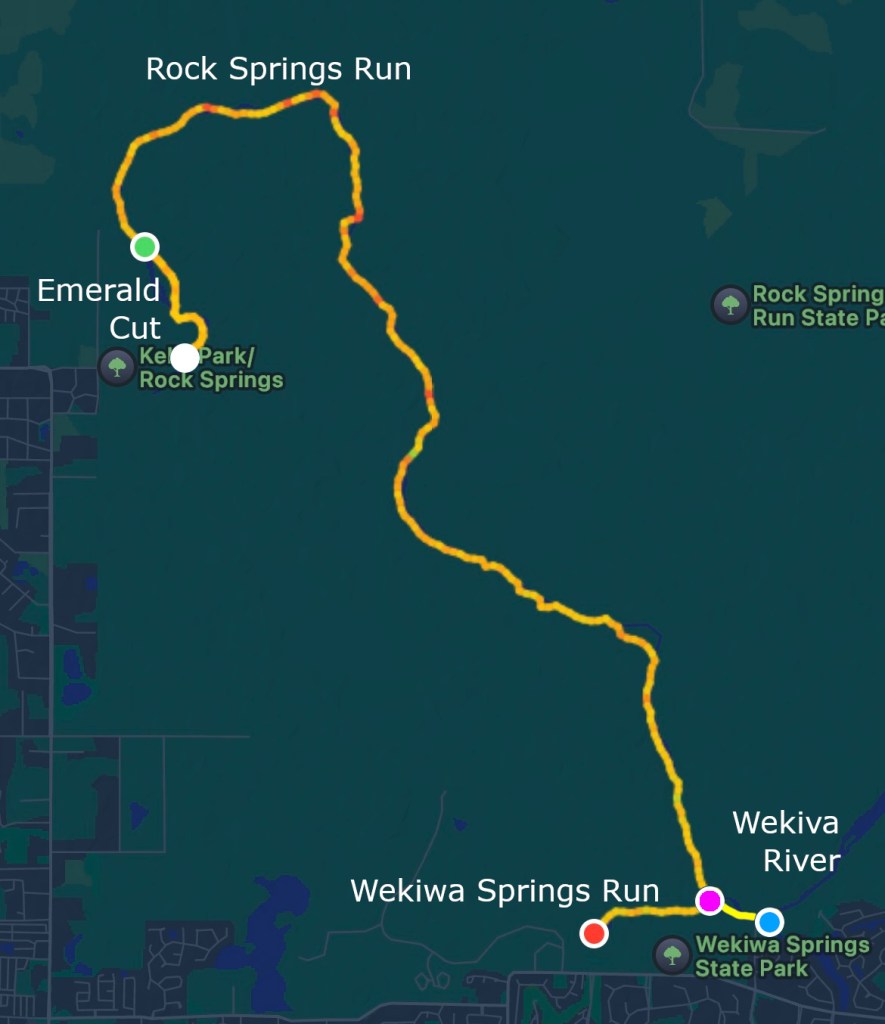
Starting at King’s Landing (green marker below), there’s a 1 mile upstream paddle named the “emerald cut” that takes you as far as Kelly Park (white marker below). You can’t paddle into the park but if you could, you’d end up at the start of the river, where the spring water is flowing out of the ground. Kelly Park offers tubing and swimming. Downstream from King’s Landing is a 7.5-mile paddle down the Rock Springs Run through wilderness (with barely any cell service) where it finally joins the Wekiwa Springs Run (pink marker below) to form the Wekiva River. The Wekiwa Springs Run is about a 3/4 mile run starting at the Wekiva Springs (red marker below) and ending when it joins with the Rock Springs Run. The final leg is from where the two runs meet (pink marker below) to Wekiva Island (blue marker below) Official map here. The Wekiva River continues for another 14 miles before it joins the St. John’s river, but we stop at Wekiva Island.

  • King’s Landing – green
  • Emerald Cut – white to green
  • Rock Springs Run – green to pink
  • Wekiwa Springs Run – red to pink
  • Wekiwa Springs – red
  • Wekiva River – pink to blue (and beyond)
  • Wekiva Island – blue

Remy’s trip

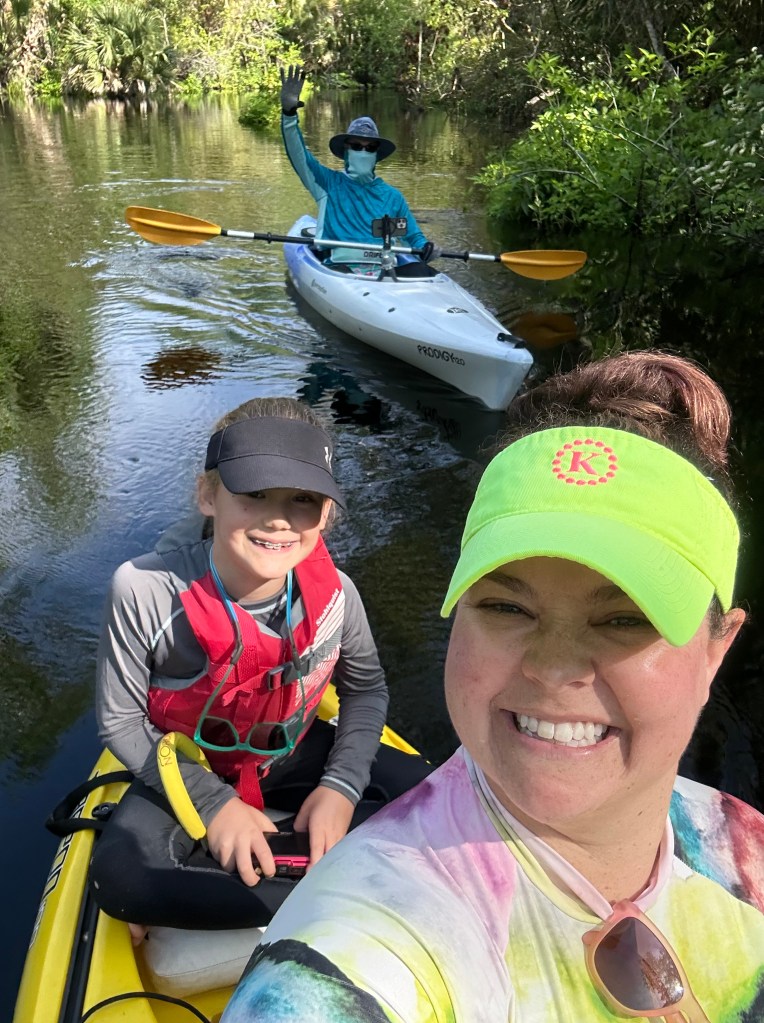
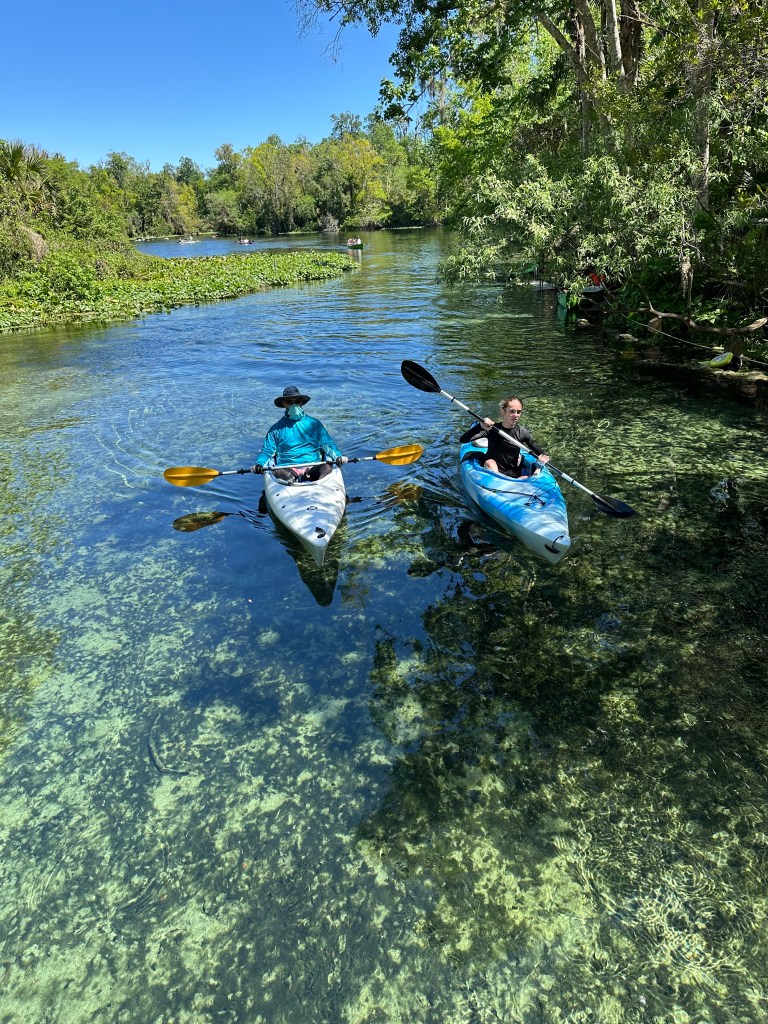
The first to make the trip with me was Remy (age 9) and Kristen. Remy rode on Kristen’s kayak. We started at King’s Landing and paddled through to Wekiwa Springs where we swam for a while before continuing on to Wekiva Island for our shuttle back to King’s Landing

Kristen made a video of our trip and posted it on Instagram. Her account is private so if you follow her, you can see it here: https://www.instagram.com/reel/DHO2MNyR1gBf1jhMnuyTkPO-CZYpE5WzLeTSIE0/

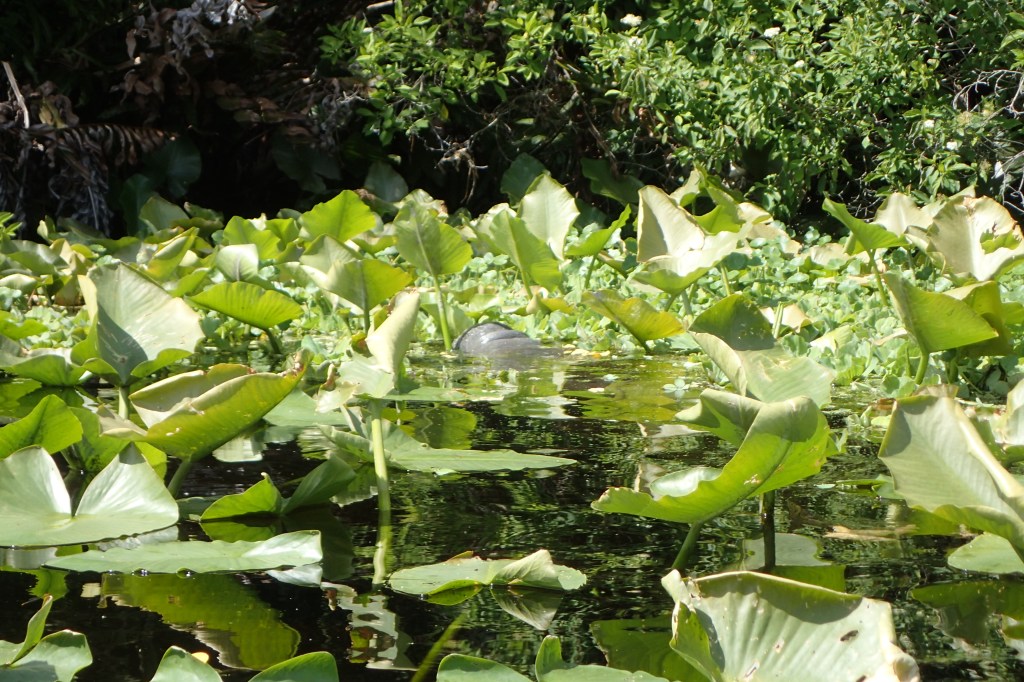
At the end of our trip, we saw a manatee! The Wekiva River is deep enough that manatees can hang out when it gets too cold and the week before our trip, it was cold enough that Wekiva Island had a few large visitors. (It’s the gray lump in this next photo)

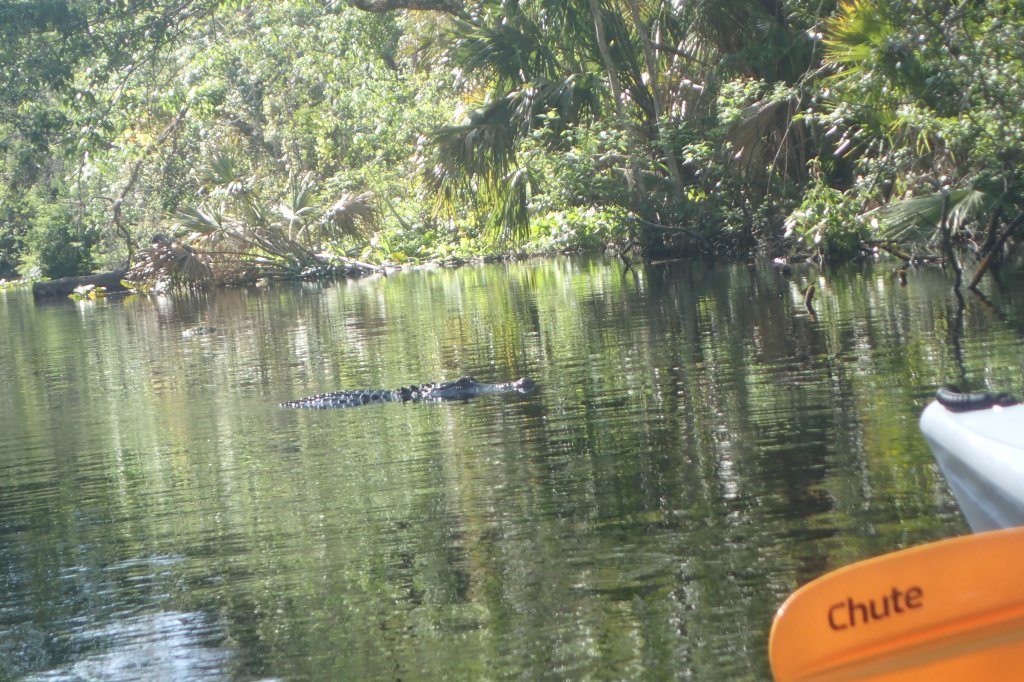
We saw a lot of wildlife! The highlights were the shy limpkins, herons, the water snake, manatee, and 23 alligators.

Jay’s Trip

Jay (age 15) accepted the challenge of paddling upstream on the Rock Springs Run starting from Wekiva Island. His goal was to paddle farther than any of his brothers, meaning he had to make it to at least mile marker 4 which would be a 9-mile round trip.

He ended up paddling the full 7.5 miles all the way to King’s Landing! It took about 4.5 hours of steady paddling and if you account for the current, it comes to around 24 miles of water paddled just on the upstream (according to my apple watch)!

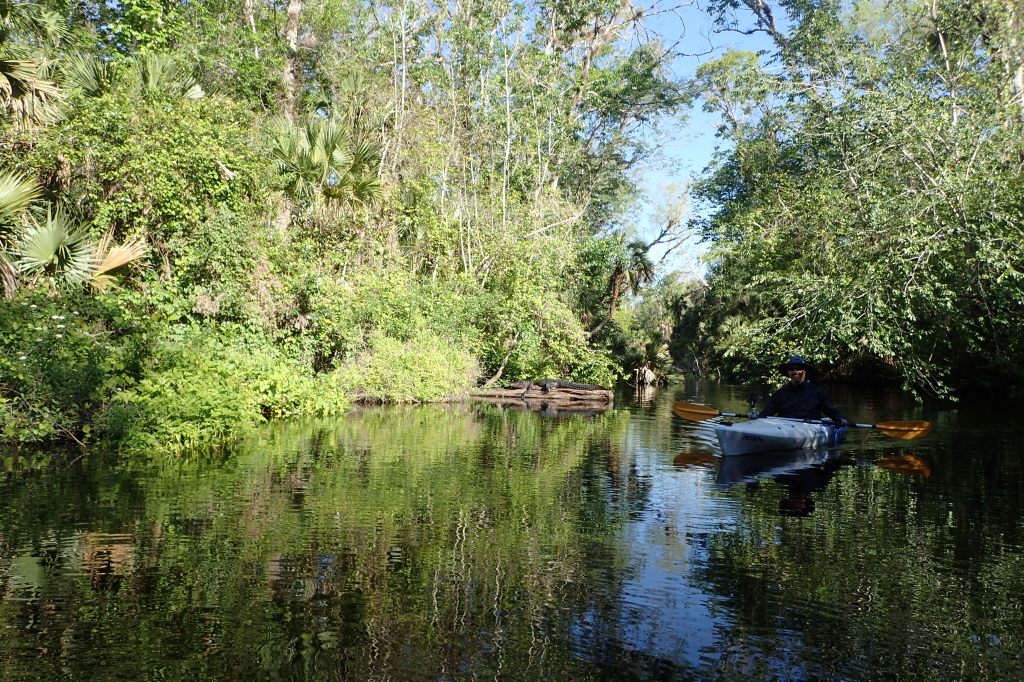
Possibly because we arrived at the main alligator habitat later in the day compared to the other paddlers or possibly just due to luck, we saw a combined 40 to 50 alligators between our upstream and downstream paddle. The most unique sighting was probably this turtle, who apparently agreed to share their premium sunning location with a gator.

Once at King’s Landing, we got out of our boats, had lunch, and stretched our legs for a few minutes. After the short break, we got back in our boats and paddled the return 7.5 mile trip in a leisurely 3 hours.
Taking a break half-way at King’s Landing

Most of the gators we see are between mile markers 2 and 5 and on this day, it seemed like there was a gator around every bend of that 3 mile stretch of river.

This gator in this last video apparently has a favorite spot to warm up, as I saw him again with Luc later in the week.

I’m so proud of Jay for tackling such a long trip. 15 miles traveled in about 7 hours! It was a great day to be out on the run.

Charlie’s Trip

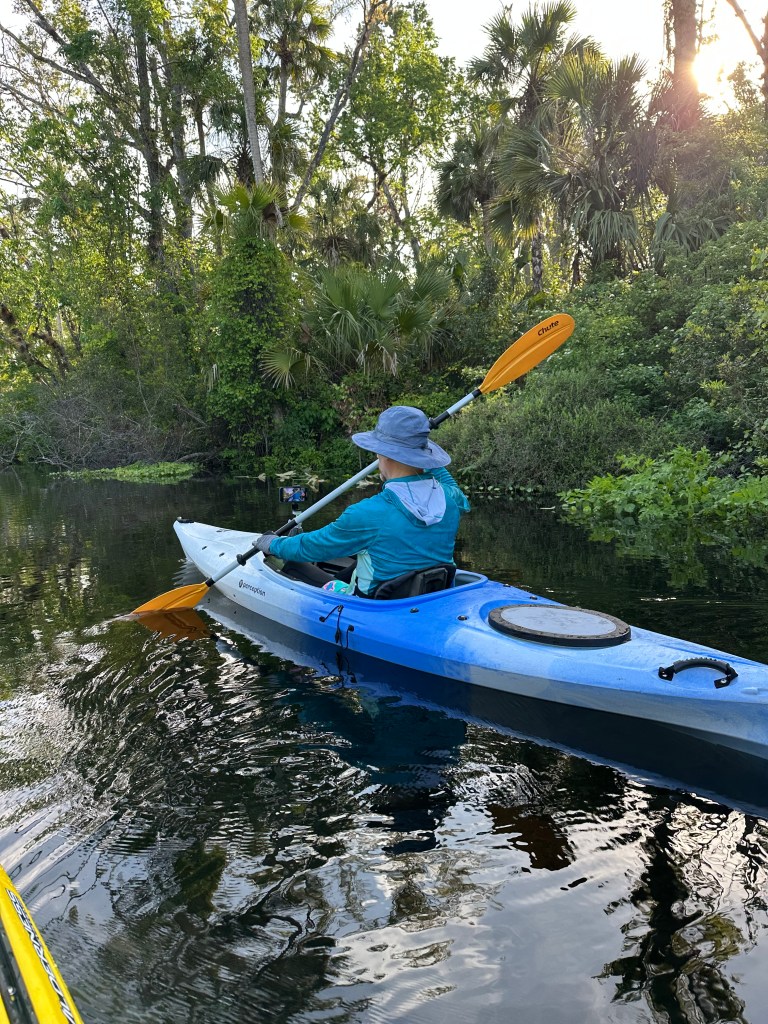
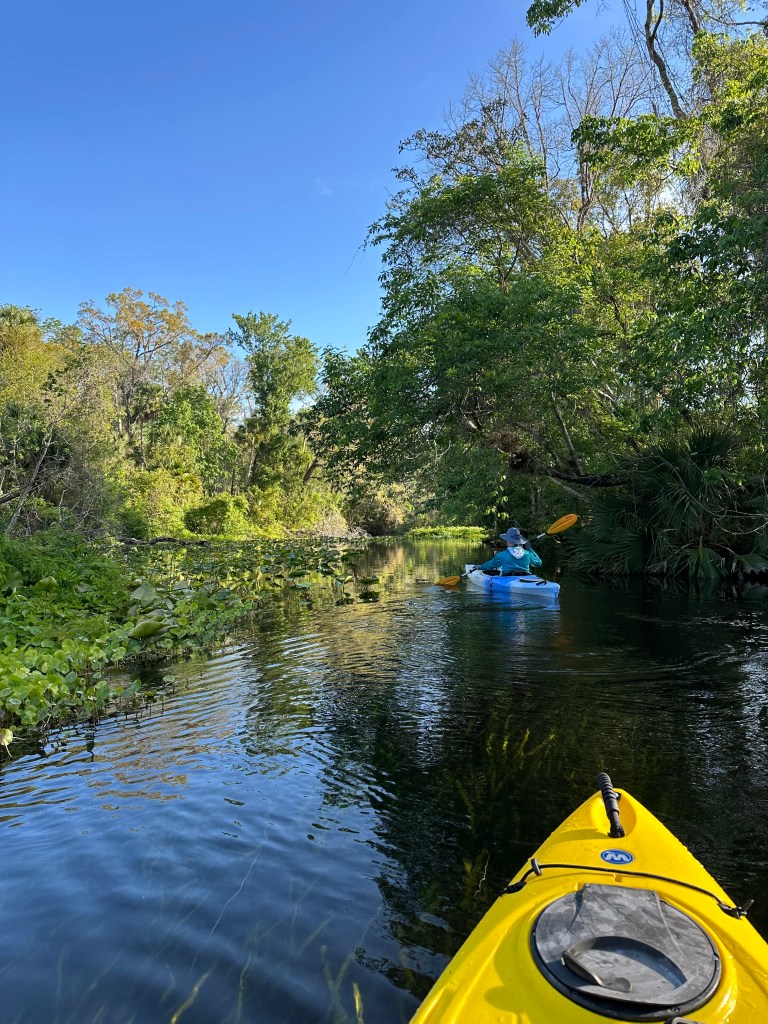
Charlie (age 13) and I started our morning by launching at King’s Landing. The morning was cold with the temperature in the high 40’s as the sun was coming up. However, the spring water is around 72 degrees all year long which meant that at the start of our paddle, it looked like we were paddling through a river out of a fantasy novel, with cool steam rising all around us.

From King’s Landing, we headed upstream to paddle the Emerald Cut. The above video is from that early morning upstream paddle and if you watch the bank of the river in the above video, you might see the deer that we spotted.

Charlie’s trip wasn’t without a few gator sightings. Being a chilly morning, we think most of them were waiting in the water for the sun to get up a bit higher.

Earlier, when Remy made the trip, he amazingly spotted a brown water snake in the cattails. When Jay and I paddled by that spot, the snake was nowhere to be found but when Charlie and I went by, it was back. See if you can spot the snake in the grass like Remy did.

At the end of Rock Springs Run, Charlie and I paddled upstream to Wekiva Springs where we met Kristen, the rest of the boys, and a few of their friends for a swim.

When it got close to 2:30, Charlie and I got back in our boats and headed to Wekiva Island to catch the shuttle.

Luc’s Trip

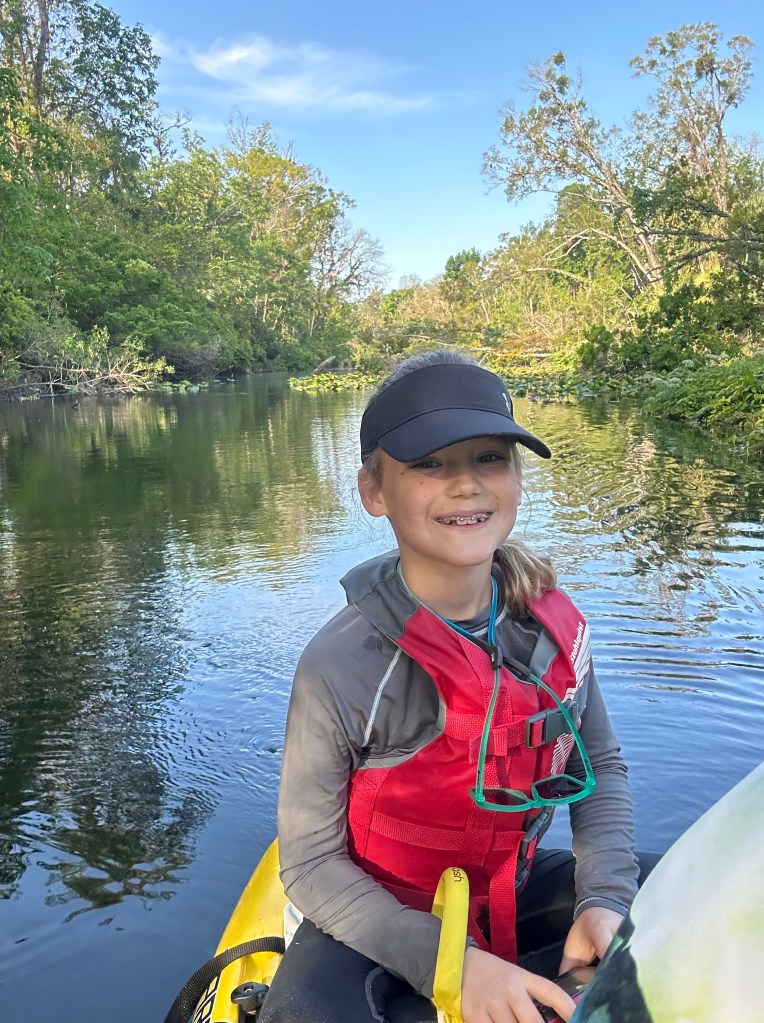
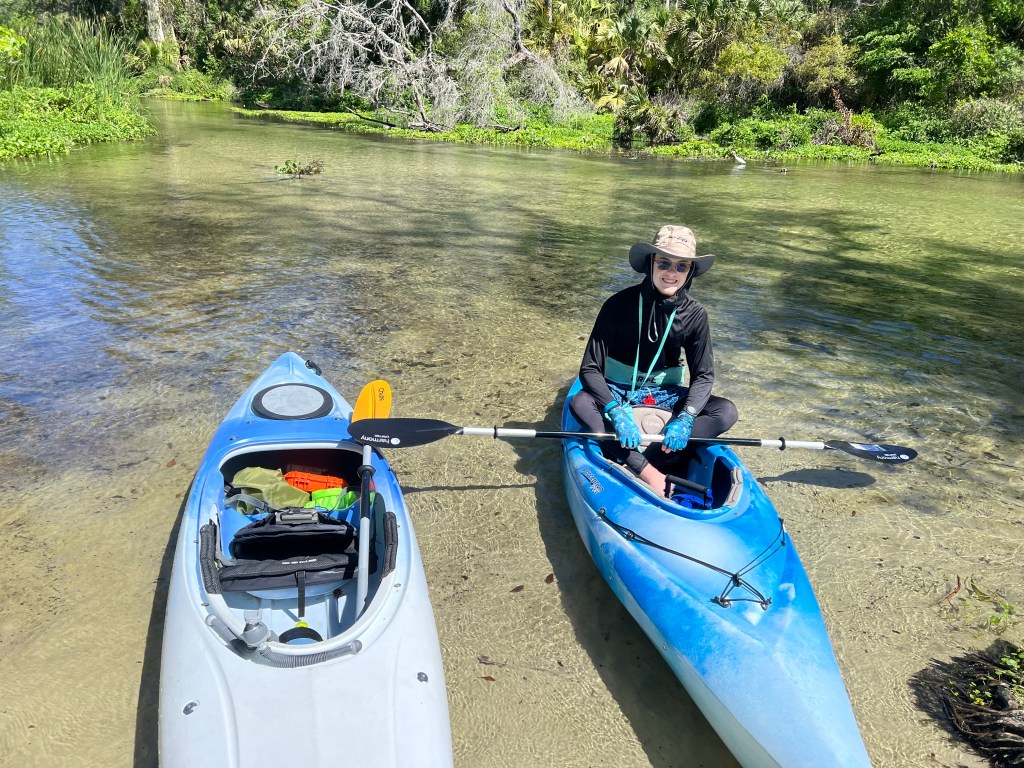
By the time Luc’s turn came around, he had listened to his brothers recount their various trips, including long lists of animal sightings (see table below). The pressure was on for him to have a great trip. Luc, at 11 years old, was the youngest to paddle the river on his own. We spent an hour the day before trying out the various kayak options to see which one would fit him the best and settled on the yellow kayak favored by Kristen.

We started our morning on the river at King’s Landing shortly after 8am and the temperature was low enough that we got to paddle through the morning steam.

We took our time paddling downstream, knowing we had all day ahead of us.

Luc paddled through the gator habitat earlier in the day than any of his brothers, likely the reason we saw the fewest gators on this day, but that’s not to say we didn’t see plenty of big ones. Imagine seeing this ahead of you in the river:

We also saw some (probably) repeat residents, like this one

And as mentioned earlier with Jay, we saw this resident in their favorite spot, right where nobody will miss seeing their large frame

We paddled through to Wekiva Springs where we swam for an hour before heading down to Wekiva Island to catch our shuttle

All four days were very special. I got to spend dedicated time with each of the boys, everyone had a great time, nobody lost any fingers, and – not that it’s a competition – everyone saw something unique.

I’d do it all again (and hopefully will)!

Animal Sightings

These are the ones we noted and wrote down. It’s a fun list, not an exhaustive one.

The only animal we consistently counted was alligators. To count birds and turtles would require a calculator and a notebook, there were so many seen

Animal SightingsJayCharlieLucRemy (and Mom)
Alligators✅ 40-50-ish✅ 17✅ 11✅ 23
Turtles
Softshell Turtle
Gopher Tortoise (threatened / endangered)✅ (seen from the truck)
Water Snake (non-venemous)
Otter (seen from the shuttle bus)
Deer✅ (seen from the truck)
Raccoon
Manatee
Wild Turkey✅ (seen from the truck)
Great Blue Heron
Little Blue Heron
Tricolor Heron
Green Heron
Kingfisher
“Shy” Limpkin
Great Egret
Snowy Egret
White Ibis
Swallow Tailed Kite
Anhinga
Pileated Woodpecker
Osprey
Night Heron

I dream of kayaks

I’ve wanted a kayak at least since I was a teenager. In the early 2000’s a Feathercraft kayak was at the top of my wish list. They made premium kayaks that would pack down into a bag for storage and travel. Priced at a premium, this was my dream kayak. I never could justify the high price tag and now they appear to be out of business.

Many years later, I started drooling over the Hobie mirage drive kayaks. The pedal system seemed like it’d be a dream to pilot. Specifically, I lusted after the Hobie Adventure Island with its removable dual amas (outriggers) and removable sail it seemed ideal since I could use it as a paddle kayak, pedal kayak, or trimaran sailboat. Unfortunately, it’s 185lbs when fully assembled (seating a single person) and it’s long and large enough that storage and transport plus setup and teardown all combine to make a boat that’s unlikely to be used often and on limited locations. A base price tag of around $5k made it hard to justify, especially since it would only carry one person.

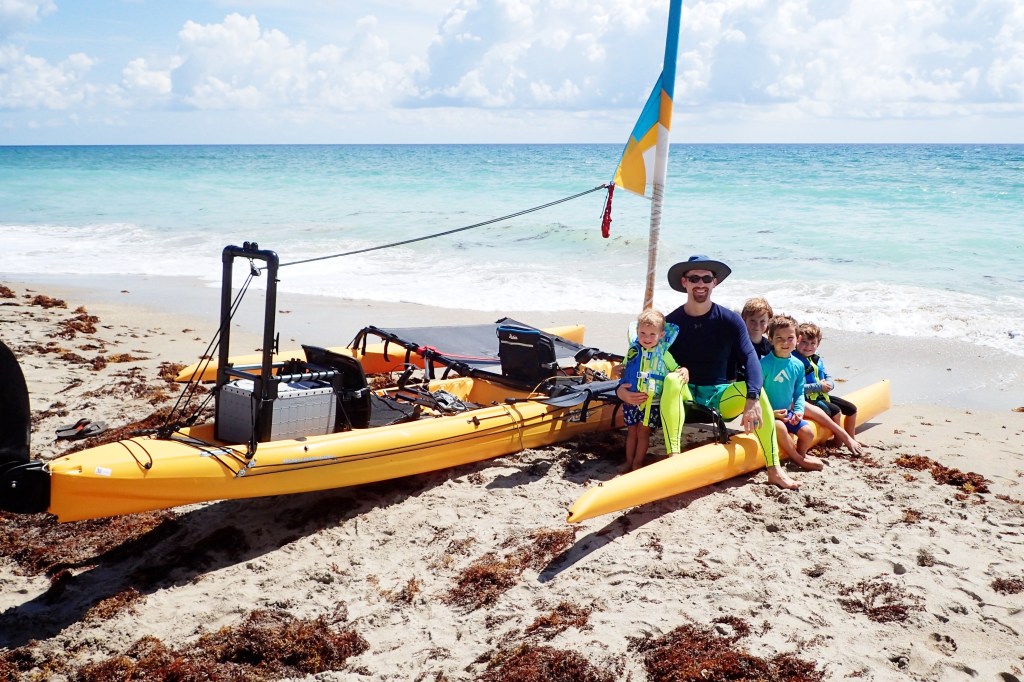
I did eventually get to try one out, as a family friend brought the tandem (two-seater) version to the beach in 2018. His version, with the trailer and all accessories was probably worth upwards of $15k. With a hull weight of 130lbs (240lbs fully assembled) and 18.5′ length, it took multiple grown men to carry the hull over the boardwalk to the beach where it was assembled for use. But once assembled, we were able to fit all 6 of us on the boat at once and had an absolute blast pedaling and sailing around in the ocean. I got to live that dream for a few days, and hauling it around, assembling, and disassembling it reinforced that it wasn’t a practical boat to own… but it was a ton of fun!

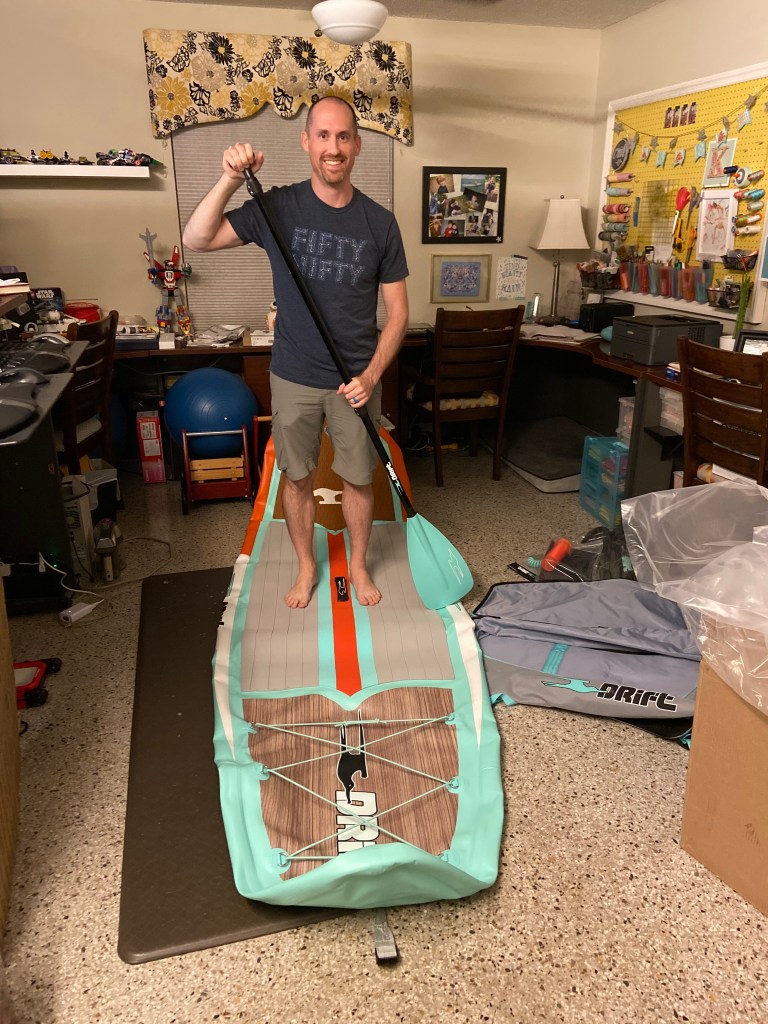
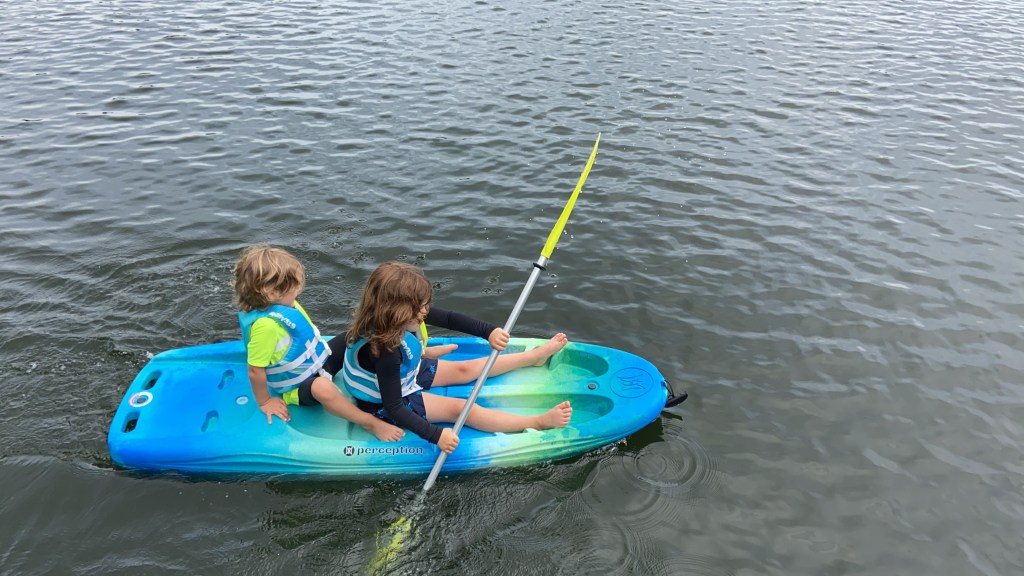
In March of 2021, I bought my first Kayak, a 6′ lifetime kayak for kids that I’d been looking at since 2016. With a weight limit of 120lbs, this wasn’t for me, but it was small, easy to store, and the boys could use it at the beach. But since one boat couldn’t hold all of us, so we got a second kids’ kayak… and two inflatable paddle boards!

These boats got a lot of use but I still didn’t own a “real” kayak. Our house was getting smaller by the day with 4 growing boys and I could never figure out where to keep a full-sized kayak.

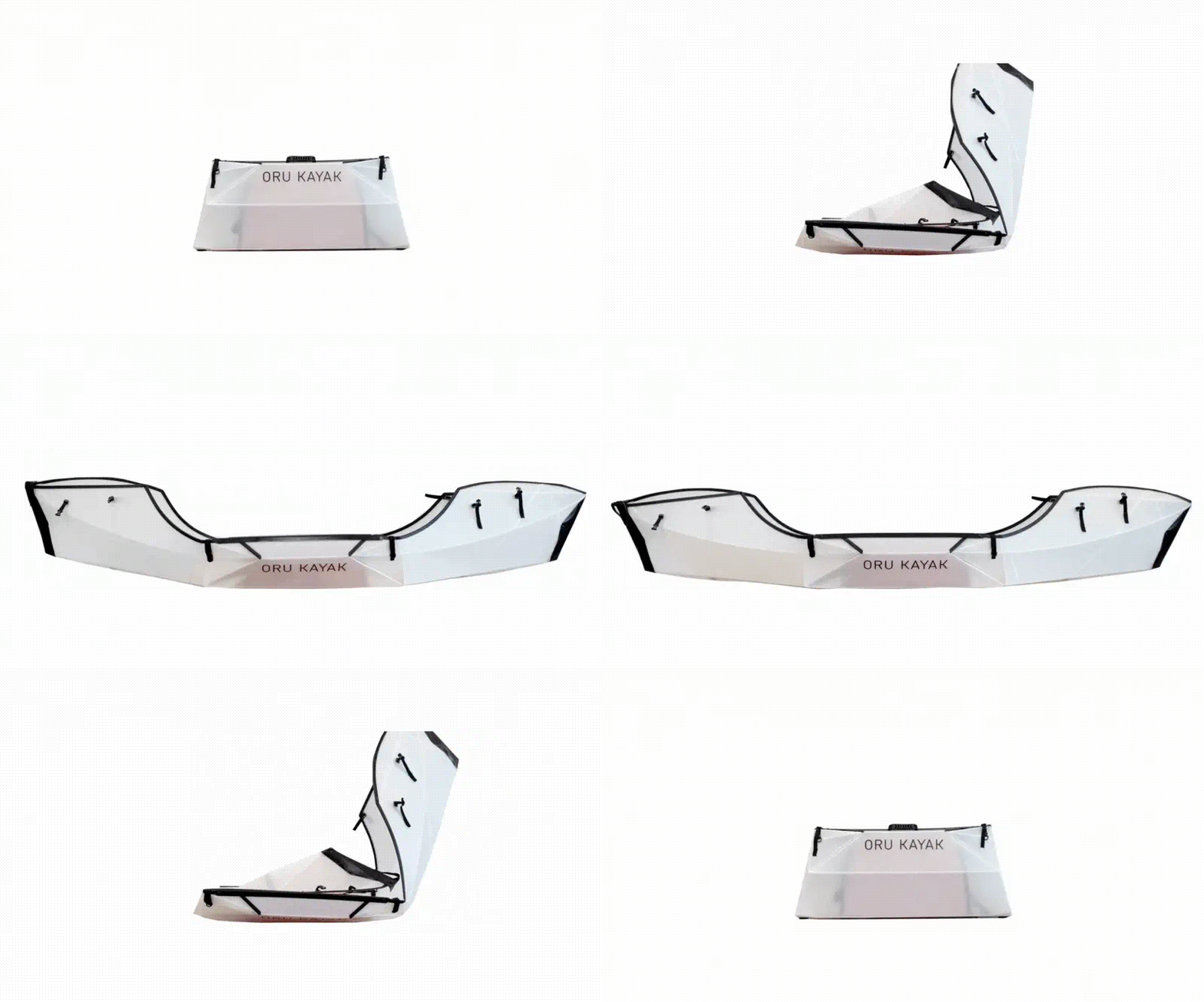
I started watching the oru kayaks that came out in 2019. Reminiscent of the feathercrafts, they fold up fairly small. Unlike the feathercraft, instead of a skin stretched over a skeleton, these are made to unfold like an origami model and claim to be very sturdy but the price is still a little high. I’m still watching these and maybe one day will add one to my collection.

Things came to a head during covid (specifically the 2020-2021 school year) when I was working from home and we had three boys doing school from home as well. We wished for more space to spread out.

I drafted up an amateur floor plan and we found a contractor in early 2022. Construction finally started in November of 2022 and finished in March of 2023, adding a new master bedroom & bathroom, office, studio, and a garage with – importantly – slightly higher ceilings than before. The new garage ceiling was perfect for kayaks since my dad brilliantly suggested that we use a garage door opener that didn’t require a track in the middle of the ceiling. I now had room for boats!

Later that year, in November of 2023, I finally became the owner of not just one, but two kayaks. They aren’t new, but two for less than the price of one was a deal I couldn’t resist.

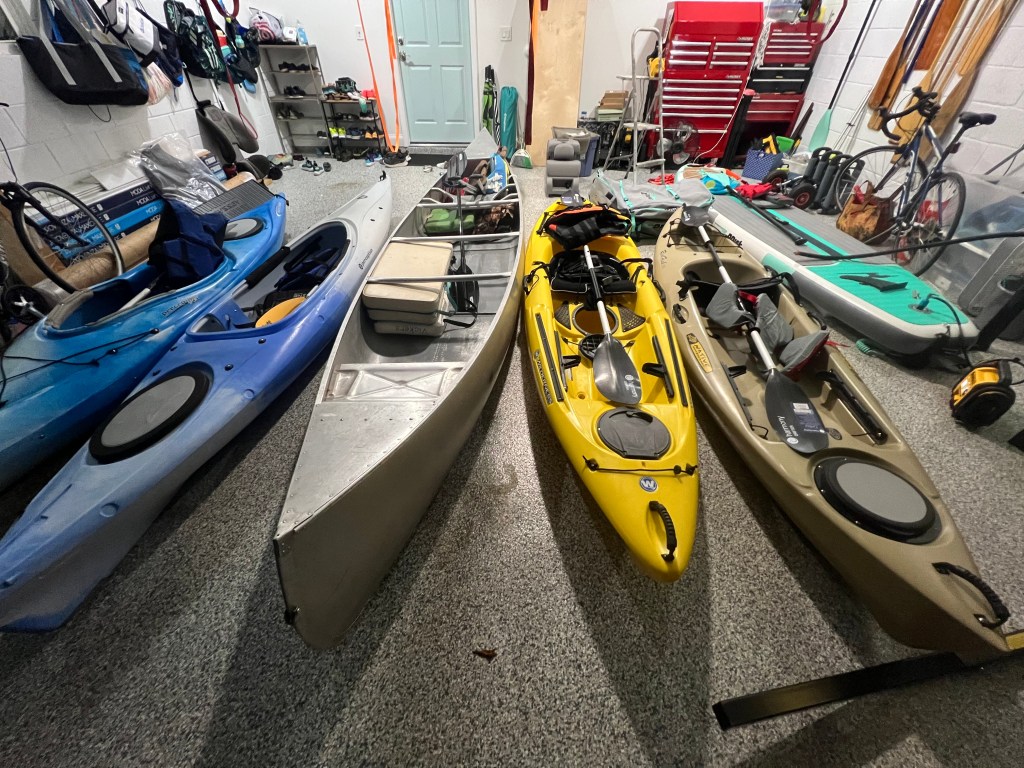
Three months later, in February of 2024, a neighbor let me know that they were moving out of state and couldn’t take their two kayaks with them. These being sit-on-top kayaks, in contrast to the two I already had, how could I say “no” to another two kayaks for less than the price of one? I now owned 4 full-sized kayaks, two kayaks for kids, and two paddle boards. We could finally go out on the water as a full family! Especially when combined with the two Canoes I inherited, we could put a lot of people on the water!

Incredibly, one month later in March of 2024, a family friend offered to give away his two older hobie mirage kayaks. Space on the ceiling of the garage was getting tight, but I was able to find room for one more boat up there :)

Oops

It’s been over 6 years since our last post and 2 years between that and the previous post. 8 years ago, in 2016, things apparently got busier than we realized. We added a 4th child to the family and Jay was in Kindergarten (he’s now 15 years old and in High School!!). It’s safe to say that we got busy enough that updating the blog became a low priority. Maybe we’ll post more now, maybe we won’t, but I’m keeping the site around just in case :)

sun protection for bikes

We love riding bikes; one of our favorite features of the house is that the back yard opens onto the Cady Way Trail. But our bikes don’t like the Florida sun. Even kept in our covered porch, enough sunlight gets through the screen to do quite a bit of damage, especially this time of year with the sun so low in the sky. Additionally, while the screen keeps out some dirt, the porch is still a pretty dirty place. Yesterday, I set out to address these issues.

Inspired by this post, I designed a shelter to store all our wheeled toys. The whole thing is made up of three independent structures, each designed so I can move it out of the porch if needed and each only as tall as it needed to be. I didn’t want to completely block our view of the back yard with this project.

The dimensions of the three structures are approximately (depth x height x width)

  • 6′ x 5′ x 4′
  • 6′ x 4′ x 4′
  • 4′ x 3′ x 3′

The first stores full-size bikes, the second stores mid-sized bikes and our two-person bike trailer and the smallest stores plasma cars and tricycles.

I drew up my plans at 9AM, Charlie and I went to the Home Depot to get supplies (in only one trip!) and I spent the rest of the day assembling. I didn’t work uninterrupted (meals, school pick-up, baths, etc.) but I finished the job the same day, at 11PM

Eventually, we’ll add a tarp or drop cloth to the front to keep out the rest of the dirt, but for now, I’m calling it done!

jay and charlie testing the frame

a view from the outside

bikes in the rack

view from the porch door

Family Circles

Kristen and I have wanted to make a printable family tree for a while and what better motivation than Christmas gifts? We looked at a few ideas and the inspiration for the design we ultimately landed on is now nowhere to be found so we can’t link to them. Anyway, below are the three family “trees” that we created. And by “we” I mean that Kristen did all the design concept work and I clicked the mouse a few times in a graphics program with her supervision. We gave these to the grandparents and any other family members whose names we happened to draw and we’re happy to print more for other family members.

Houghton family circle

Vickers family circle

Perreault Family Circle

I will also point out that my very compulsive wife insisted that all photos be chronological by birth. Whether the aesthetics worked best clockwise or counter-clockwise, the second generation is in age order and then the third generation is in age order while staying within the bounds of their parents, etc.

Unfortunately, we didn’t do a circle for Kristen’s Dad’s family, the Westlakes. We don’t get to see that extended family often and obtaining all the required pictures would have been exceedingly difficult.

Thank you

Just a quick note to say “Thank You” to our vets at Tuskawilla Oaks Animal Hospital and the veterinary specialists at AVS for helping us provide Dolce with the care he needed to live 6 more months with us. We wish his time hadn’t been cut so short, but we are thankful for the time that we had. (Except for the first few weeks of recovery, you wouldn’t have known that he had been through major surgery.) The compassion shown by both offices is very much appreciated.

Dolce cared for us long before we had to care for him. When Kristen was pregnant with Jay (August 2009), Dolce made sure she took it easy and stayed warm

And later, when both Jamie and Jay were sick (June 2011), Dolce was there to make sure we got better

When Dolce returned from the Vet (September 2011), he had a little sweater on to hold a feeding tube in place, but he still wanted to be where everyone was, a part of the action

And even though he wasn’t back to 100% himself, he kept Jay company when Jay wasn’t feeling well, cuddling up next to him while Jay watched a movie